Final Draft
Venus Marie Gautreau
3977 Sedgwick Avenue, 10463, apartment 12G.
914-314-9741
Dear Franco Colombo Russell
The title of my paper is “AAVE: Discrimination in Education, Workplace, and Media”, a synthesis essay with a word count of 1607.
This synthesis essay is about the discrimination that people who use AAVE face within the spheres of education, the workplace, and the media, which often enforces a long-standing racial hierarchy in the United States, and the idea that there is only a singular “correct” form of English.
In this phase, I learned to think more critically when I write, piecing together information to create a writing piece that further proves a thesis I made. I also learn how to gather sources more efficiently, format a research paper, and how to more correctly write a research paper. I have learned to be more critical of what I’m doing and to be clearer and more concise in my writing to draw in more readers.
The audience of my literary essay is those who don’t truly realize the extent of the discrimination that black Americans who use AAVE face. I tailored my writing to be more critical, to further reach audiences who may not be the same as me, showcasing a professional, critical side to my writing. Meaningful insights I have gained from taking one a more, formal academic tone within my writing is that people tend to take what you are writing more seriously if you “sound professional”, and that sometimes, in trying to write in more academic language, it can lead to you writing in a way that, although sounds like everyone else, can be understood by many in the academic field. Concepts that have more impacted my learning and writing practices are the idea of professionalism and conciseness in my writing; it forced me to write in a way that is very different than how I’d typically write, reaching a new audience that I don’t typically reach with most of my writings. This has led me to become more confident in academic writing because it forced me to try and further learn what academic writing looks like. The purpose in tying quotes together helped me to connect ideas and further strengthen my writing as a college student.
Thank you very much for reading my letter, essay, and for viewing my presentation.
Sincerely,
Venus Marie Gautreau
Venus (Paulette Marie Gautreau)
Professor Russell
ENG 110
October 31st, 2025
AAVE: Discrimination in Education, Workplace, and Media
Within American society, there’s often a bias towards individuals who do not speak what is considered to be “standard English”. This bias is commonly seen implemented within the sphere of education, workplaces, and media across the United States, leading to discrimination against those who do not speak what is considered to be the standard of “how one should speak”. Let’s begin to examine how Black Americans who use African American Vernacular English (AAVE) face systemic discrimination within education, employment, and media due to accent and language bias, showcasing that this prejudice is rooted in racism and challenges notions of intelligence, professionalism, and identity.
What is African American Vernacular English? African American Vernacular English (AAVE), formerly known as Black English Vernacular/Ebonics, is a distinct variety of English with its own unique form of grammar, pronunciation, and vocabulary, primarily spoken by Black Americans within the United States of America.
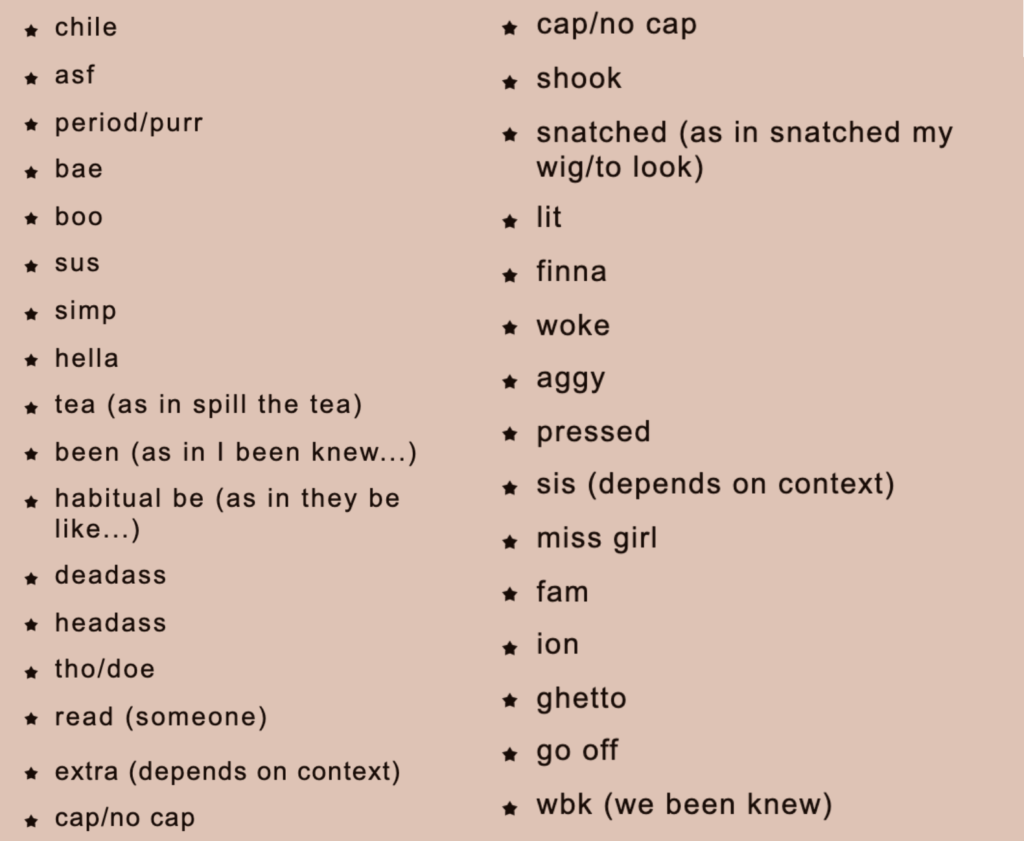
In the 17th century, when Africans were originally brought to the Chesapeake and Southern colonies, they encountered a variety of English dialects spoken by indentured servants, frontier settlers, and later, by the European colonists. Scholars argue that these speakers learned English through second-language acquisition, shaped by grammar and African influences. By the 19th century, as the enslaved population increased and migration between different regions intensified, the emerging speech community assimilated features from surrounding white English and retained distinct African-influenced grammatical patterns. AAVE spread across the US with the movement of Black people, seen in The Great Migration. According to the Garfield Messenger, “millions of Black folk moved to all corners of the country, fleeing Jim Crow and the KKK in search of opportunities for a better life” (The Garfield Messenger, 2). With the spread of AAVE, each region developed distinct differences. Additionally, over time, AAVE has also influenced standard English, with modern slang such as “bet”, “cap”, and “finna” becoming increasingly popular with younger generations (such as Gen Z and Gen Alpha). So it’s interesting how something that is influencing standard English today is used to discriminate against black Americans.
Education is meant to be a safe space for all, not only to learn and grow as students, but also as individuals. However, it is often clear that education within the United States has its many flaws. One of the many concerning flaws is how African American Vernacular English is discriminated against within academia. We often see discrimination begin early in various aspects, such as housing searches, job searches, and even early education. When curricula devalue the way someone speaks, a person’s language, it devalues them as a human. In the book Performing Literacy by Rebecca Rodgers and Melissa Mosley Wetzel, it discusses how, from as early as Pre-K to high-school level assessments, speakers of AAVE are time and time again judged as being less capable, a judgment which often mirrors racial hierarchies within our society. “Empirical studies cited show that speakers of non‑standard varieties (including AAVE) are perceived as less intelligent and less professional, even when content is identical.” In addition, Neighborhood effects on use of African-American Vernacular English, states, “Such evidence is also relevant for understanding how changes in segregation will affect disparities in other life outcomes because previous studies suggest that AAVE use could affect children’s school success, at least given the way schools currently operate … and that AAVE speakers are often victims of what Baugh calls ‘linguistic profiling’ … discrimination in the workplace, housing markets, and schools.” This judgment leads to students who use AAVE being less motivated to learn, leading to lower academic achievement. Lower academic is not caused by a “lack of ability”, but rather by the discrimination that students who use AAVE face, for years, dating back to pre-school. The institutionalization of discrimination in the educational sphere sets students who use AAVE up for failure, while uplifting those who use what is considered “standard English” (which is more heavily Eurocentric) tends to be uplifted. When schools judge these students as being less capable, students’ successes are limited, and racial hierarchies continue to be enforced within society. The peer-reviewed article, Neighborhood effects on use of African-American Vernacular English states, “African-American Vernacular English (AAVE) is systematic, rooted in history, and important as an identity marker and expressive resource for its speakers.” This is important regarding education because when educators treat AAVE as something that is “incorrect” or “lacking grammar”, they go on to completely ignore the legitimacy and the cultural ties that the language has.
In employment, speakers of AAVE often face systematic discrimination within employment, due to their way of speaking being mischaracterized as “unprofessional” or “lacking intelligence”. Findings in, Neighborhood effects on use of African-American Vernacular English, showcase how lower usage of AAVE correlates to higher income, revealing the linguistic bias within the workforce. This often tends to operate within what is known as linguistic profiling- the process by which race is identified via speech, and is thus used to discriminate. Thomas and Reaser both found that listeners (in a review of speech identifying studies, differentiating European American and African American voices) were able to “accurately and consistently identify voices as African American or European American” (Thomas and Reaser 1), which showcases how AAVE can serve as a racial marker in hiring and the workplace. Kubota and Lin go on to explain that what is considered the “ideal English speaker” tends to be white and middle class, showcasing how views on what is or isn’t professional can often be racially coded (Kubota and Lin, 55). AAVE is mislabeled as “unprofessional”, but it becomes clear that black identity is being judged and mischaracterized. The expectation in the US is to “sound white”, thus forcing those who use AAVE in their everyday lives to have to code-switch, lessening the authenticity of how they speak, and reinforcing the racial idea that whiteness is linked to professionalism within the workforce.
For a long time, the entertainment and news industries within the USA favored “standard” English, usually white, middle-class speech patterns, while disadvantaging AAVE speakers. A 2023 NBCU Academy feature noted how black journalists with Southern/AAVE inflections reported being told to “sound more professional,” which implies that their natural manner of speaking was not suitable for broadcast (NBCU Academy, 2), thus reflecting linguistic profiling. Due to negative stereotypes about black language, African Americans are excluded from both professional and public spaces, which include news stations and entertainment. Stereotypes within the media often reinforce linguistic discrimination. Within Hollywood, we see characters who use AAVE being portrayed as comedic, rebellious, or hypermasculine, while black characters who don’t use AAVE are portrayed as being successful and educated (Craig, 619), implying that you cannot speak in your natural form of English and be viewed as successful. Rogers and Wetzel argue that the use of language is a “performance of identity”, and when AAVE is mocked and excluded within American media, black identity is constrained and put into a small set of roles that are seen as “acceptable” (Rogers and Wetzel, 10). This leads to many black professionals altering their speech patterns to avoid prejudice within the media/public roles, which we often see isn’t the same scenario for their white counterparts.
Linguistic discrimination in media is a more subtle form of systemic racism, devaluing black ways of speaking and being. It limits opportunities for AAVE-speaking actors, creators, and journalists, and shapes how the audience understands intelligence, authenticity, and professionalism. Understanding the accent and linguistic bias within media is important to creating a space that accepts and values AAVE.
African American Vernacular English reflects culture, history, and identity. However, within education, workplaces, and media, it is often judged and devalued. The discrimination AAVE speakers face is deeply rooted in racism disguised as “professional” speech, equating white with intelligence and professionalism. Recognizing AAVE as a legitimate, systematic form of English challenges biases and leads to more inclusivity within education, workplaces, as well as media.
Works Cited
The Garfield Messenger. “A Brief History of AAVE.” The Garfield Messenger, 26 Feb. 2021, www.garfieldmessenger.org/6418/articles/news/a-brief-history-of-aave/.
Bailey, Guy. “The History of African‑American Vernacular English.” Oxford Research Encyclopedia of Linguistics, Oxford University Press, 15 Aug. 2022, https://doi.org/10.1093/acrefore/9780199384655.013.926. Accessed 31 Oct.
Kubota, R., & Lin, A. M. Y. (2009). The Ideal English Speaker: A Juxtaposition of Globalization and Language Policy in South Korea and Racialized Language Attitudes in the United States R ACH E L A . g R AN T A ND I N CHO LEE. In Race, Culture, and Identities in Second Language Education (pp. 54–73). Routledge. https://doi.org/10.4324/9780203876657-8
Rickford, J. R., Duncan, G. J., Gennetian, L. A., Gou, R. Y., Greene, R., Katz, L. F., Kessler, R. C., Kling, J. R., Sanbonmatsu, L., Sanchez-Ordoñez, A. E., Sciandra, M., Thomas, E., & Ludwig, J. (2015). Neighborhood effects on use of African-American Vernacular English. Proceedings of the National Academy of Sciences – PNAS, 112(38), 11817–11822. https://doi.org/10.1073/pnas.1500176112
Stacy Denny. (December 31, 2012 Monday). Looking back while moving Forward: When teacher Attitudes Belie Teacher Motive in Bidialectal Classrooms. International Journal of Learning and Development. https://advance-lexis-com.ccny-proxy1.libr.ccny.cuny.edu/api/document?collection=news&id=urn%3acontentItem%3a57YD-6TR1-DXH0-K2K9-00000-00&context=1519360&identityprofileid=X9T9Z451612.
Craig, C. (2017). Courting the Abject: A Taxonomy of Black Queer Rhetoric. College English, 79(6), 619–639. https://doi.org/10.58680/ce201729160
Thomas, E. R., & Reaser, J. (2004). Delimiting perceptual cues used for the ethnic labeling of African American and European American voices. Journal of Sociolinguistics, 8(1), 54–87. https://doi.org/10.1111/j.1467-9841.2004.00251.x
Rogers, R., & Wetzel, M. M. (2014). Performing Literacy: Multimodal discourse analysis. In Designing Critical Literacy Education through Critical Discourse Analysis (1st ed., pp. 85–98). Routledge. https://doi.org/10.4324/9780203070864-6
Linguistic profiling. (2003). In Black Linguistics (pp. 167–180). Routledge. https://doi.org/10.4324/9780203986615-17
American, African. “Lizzy on Language.” Lizzy on Language, 19 Jan. 2021, lizzyonlanguage.com/blog/african-american-vernacular-english.
Ainsworth, Harry. “What Is AAVE and Which Words Are Non-Black People Being Asked to Avoid?” The Tab, 15 Apr. 2021, archive.thetab.com/uk/2021/04/15/aave-words-202195. NBCU Academy. “Why Black Southern Accents Are Missing from Broadcast News.” NBCU Academy, 18 Apr. 2023, nbcuacademy.com/black-southern-accent-discrimination-broadcast-news/.

This entry is licensed under a Creative Commons Attribution-NonCommercial-ShareAlike 4.0 International license.

